


Introduction: Why Your Quotes Never Seem to Match What You Asked For
If you've ever sourced medium-voltage equipment for an overseas power project, you've probably run into this exact situation: you search "35kV movable switchboard," send inquiries to a handful of Chinese manufacturers, and the quotations that come back are labeled "drawout metal-clad switchgear" or reference model codes like "KYN" or "JYN." The specification sheets look thorough, but you're left wondering whether you're even comparing the same product.
This isn't a coincidence - it reflects a genuine terminology gap in this niche market. "Movable switchboard" is the phrase procurement teams naturally search for, while the equipment itself is formally classified as "drawout-type metal-clad switchgear." Missing this distinction doesn't just slow down your comparison process; it can lead to ordering equipment whose internal structure doesn't actually match your project's maintenance requirements - a mistake that's far more expensive to fix after delivery than to avoid upfront.
This guide won't repeat a spec sheet. Instead, it will help you understand what the term actually means, when a movable/drawout design is genuinely necessary, and which details to check before signing off on a supplier.
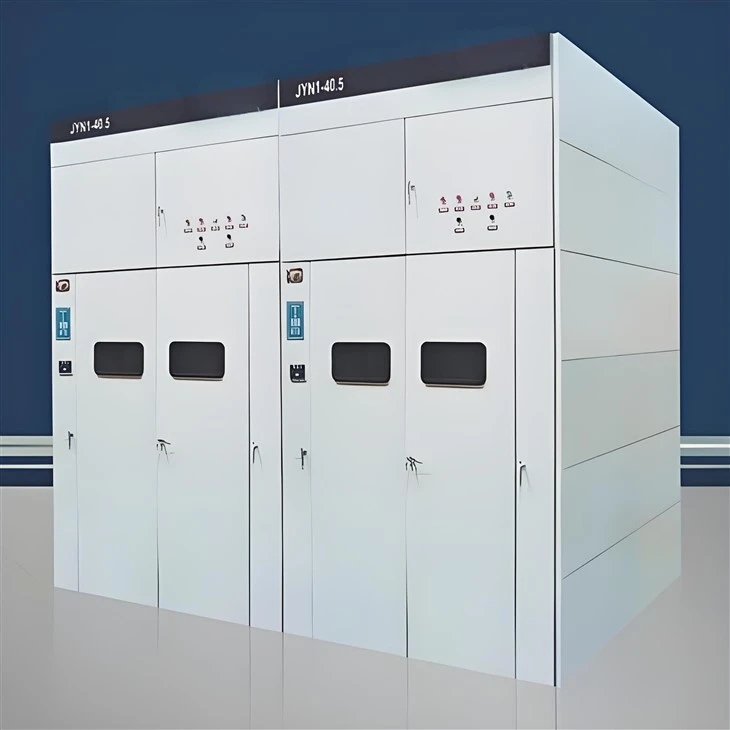
JYN1-40.5 Compartmentalized Drawout AC Metal-Clad Switchgear
1. Clearing Up the Terminology: What Actually "Moves"
Many buyers assume "movable switchboard" means the entire cabinet can be relocated. In 35kV-class medium-voltage equipment, though, the term almost always refers to an internal mechanism, not the cabinet itself.
Industry standards (IEEE C37.20.2, aligned with ANSI classifications) divide medium-voltage switchgear into two broad categories:
Metal-enclosed switchgear: fewer internal compartments, with circuit breakers usually bolted in place. Maintenance typically requires shutting down the entire unit.
Metal-clad switchgear: strictly compartmentalized into separate busbar, breaker, cable, and relay sections, with the circuit breaker mounted on a drawout truck that can be moved between "connected," "test," and "disconnected" positions - without removing the whole cabinet.
In practice, when the market refers to a "35kV movable switchboard," it's describing this drawout metal-clad design - the breaker unit moves, not the enclosure. Gangheng Electric's JYN1-40.5, for example, uses withdrawable trucks with clearly defined test and service positions, letting technicians pull a breaker for maintenance while adjacent bays stay energized. That's the practical meaning of "movable" in this context.
Sourcing tip: when sending an RFQ, don't rely on "movable switchboard" alone - add "drawout circuit breaker design" to your description. It removes ambiguity and helps suppliers return a technically accurate proposal on the first pass, saving several rounds of back-and-forth clarification.
2. When You Actually Need a Movable (Drawout) Design - And When You Don't
Not every 35kV project needs drawout construction. Before comparing quotes, it helps to answer three questions:
Is maintenance frequency high?
Facilities with fluctuating heavy loads - steel plants, mining operations, data centers - tend to need frequent breaker servicing. A drawout design lets maintenance crews pull and test a breaker without interrupting neighboring feeders, which reduces cumulative downtime over the equipment's service life. For lower-demand commercial buildings, a fixed-type panel (such as an XGN-series box-type switchgear) is often the more cost-effective choice.
Does the project require sectional maintenance without a full shutdown?
Substations and power plant incoming/outgoing lines usually require that one section can be serviced while the rest of the system keeps running. This is exactly where the compartmentalized structure of metal-clad switchgear pays off - each functional section is isolated, so a fault or maintenance action in one compartment doesn't propagate to others.
Is future expansion likely?
Withdrawable trucks are typically interchangeable - circuit breaker, isolating, lightning arrester, and voltage transformer units can often be swapped within the same cabinet frame. That flexibility matters for phased industrial parks or renewable energy projects that expect to add functional units later without redesigning the whole switchgear line.
If your project has low maintenance frequency, a tight budget, and no requirement for sectional isolation, a fixed metal-enclosed design may deliver better value than paying for drawout functionality you won't use. Selection should be driven by operating requirements first - not by defaulting to the more "advanced-sounding" option.
3. Cost Control: Three Hidden Factors Buyers Often Miss
Total cost of ownership for 35kV equipment isn't just the unit price on the quote. Three factors are easy to overlook during initial comparison:
- Short-circuit rating margin. Sizing strictly to today's load often means a full replacement is needed the moment the facility expands. Using reference figures such as 25/31.5kA breaking current and 63/80kA peak withstand current as a benchmark, it's worth building in a 15–20% margin rather than sizing to the exact current requirement.
- Environmental adaptability that wasn't confirmed upfront. Projects in humid, high-altitude, or seismic regions need switchgear rated accordingly - anti-condensation heaters, humidity tolerance, and seismic resistance (commonly rated to Grade 8) aren't always standard. Adding this protection after installation typically costs more than specifying it at the outset.
- Non-standardized truck interchangeability. If the drawout mechanism isn't standardized, future spare parts and upgrades may be locked to a single supplier, weakening your negotiating position for years. Always ask for documented truck interchangeability before ordering.
4. A Sourcing Checklist: How to Vet a Supplier from Overseas
Since on-site factory audits aren't always practical for cross-border buyers, certification documents and technical responsiveness become the most reliable signals of supplier quality:
Verify management system certifications. ISO 9001 (quality) and ISO 14001 (environmental) are baseline indicators of a disciplined manufacturing process.
Request the type test report. This document confirms the switchgear has actually passed short-circuit, temperature-rise, and other rigorous tests - don't rely on verbal claims about ratings alone.
Check for verifiable export track record. Suppliers with documented projects in regions with similar grid standards or climate conditions typically carry lower delivery risk.
Assess technical drawing responsiveness. During the inquiry stage, a supplier's ability to clearly walk through the main circuit diagram, layout plan, and secondary control schematics is often a better indicator of engineering competence than a trading company simply forwarding a catalog.

GangHeng - 35kV Movable Switchboard Factory
Conclusion: Actionable Next Steps
When issuing an RFQ, use both "movable switchboard" and "drawout metal-clad switchgear" to reduce miscommunication with suppliers.
Determine your project's maintenance frequency, sectional isolation needs, and expansion plans before deciding whether drawout construction is actually necessary - don't pay for capability you won't use.
Pay close attention to short-circuit current margin, environmental ratings, and truck interchangeability, since these are the most commonly overlooked cost drivers.
Request ISO certifications and type test reports, and prioritize suppliers with a verifiable overseas project history before finalizing an order.
FAQ
Q1: Can a 35kV movable switchboard be swapped directly for a fixed-type switchgear?
No. The two have fundamentally different internal structures. A movable (drawout) design relies on dedicated truck rails and secondary contact mechanisms that a fixed-type panel doesn't have, so this decision needs to be made during initial selection, not after installation.
Q2: Which is better for a 35kV substation project - metal-clad or metal-enclosed switchgear?
If the project requires sectional maintenance without a full shutdown, metal-clad drawout designs such as the 【此处建议链接至JYN1-40.5产品页】JYN1-40.5 are the appropriate choice. For simpler distribution with infrequent maintenance, fixed metal-enclosed switchgear usually offers better value.
Q3: Does maintaining a drawout circuit breaker require shutting down other sections?
No - that's the core advantage of the drawout design. The breaker truck can be withdrawn independently to a test or maintenance position while adjacent bays continue operating normally.
Q4: How do I confirm a 35kV switchgear unit can handle high-altitude or high-humidity conditions?
Ask the supplier for specific environmental ratings (maximum altitude, average daily humidity tolerance, seismic grade) and request either a type test report or references from projects in comparable climates.
Q5: What's the most commonly overlooked spec when comparing 35kV movable switchboard quotes?
The margin on short-circuit breaking and peak withstand current, along with whether the internal trucks are standardized for interchangeability - both directly affect future expansion cost and long-term maintenance flexibility.