

A hospital backup power system is not simply a generator connected to a standby panel. During a utility outage, the electrical system must continue supplying loads according to their operational importance, while maintenance and fault isolation must be handled without creating unnecessary disruption. In U.S. healthcare applications, for example, Type 1 essential electrical systems can include separate life-safety, critical, and equipment branches, with automatic transfer arrangements for the relevant branches.
That makes switchgear selection a system-design decision rather than a simple product purchase. For hospital and healthcare projects, buyers should look beyond rated current and ask whether the selected Low Voltage Withdrawable Switchgear, Modular Low Voltage Switchgear, and Motor Control Center (MCC) Cabinet configuration actually matches the facility's critical loads, maintenance strategy, protection requirements, and future expansion plans.

Why Hospital Backup Power Requires a Different Switchgear Approach
Hospitals combine several very different types of electrical loads. Critical-care areas may rely on electrical medical equipment, while other parts of the facility require lighting, communication, ventilation, pumps, HVAC equipment, and general building services. The importance of maintaining each load is not identical.
This is why the first step in specifying Low Voltage Withdrawable Switchgear should be a load assessment rather than choosing a cabinet model. The project team should identify which circuits belong to essential or critical power systems, what their operating currents are, whether they are single-phase or three-phase, and how they are expected to behave during a utility outage.
The exact arrangement also depends on the applicable local electrical and healthcare codes. IEC/TR 61439-0, for example, takes a functional approach to specifying low-voltage assemblies and emphasizes defining the characteristics required for the intended application before the manufacturer produces the assembly.
This principle is particularly important in hospitals: the switchgear should be configured around the electrical system, not the other way around.
Why Consider Low Voltage Withdrawable Switchgear?
One of the main reasons to consider a withdrawable design is maintenance flexibility. In a withdrawable assembly, individual functional units can be isolated or removed according to the design, making maintenance more targeted than working on a completely fixed arrangement.
That can be valuable in healthcare facilities where electrical maintenance needs to be carefully coordinated with ongoing operations. The practical objective is not simply "faster maintenance"; it is to reduce the number of circuits affected by a maintenance activity and provide a more structured way to isolate equipment.
IEC 61439-2 specifically includes requirements for withdrawable and removable parts within low-voltage assemblies.
However, withdrawable construction does not automatically make a switchgear system suitable for every hospital. The complete design still needs to address protection coordination, short-circuit withstand capability, interlocking, incoming and outgoing circuit arrangements, transfer equipment, physical space, and the operating procedures required by the project.
In other words, withdrawable is a design feature, not a substitute for proper system engineering.
Modular Low Voltage Switchgear: More Than a Drawer Design
The terms "modular" and "withdrawable" are sometimes used as though they mean the same thing, but they describe different aspects of a switchgear system.
Modular Low Voltage Switchgear refers to a configuration built from standardized functional sections or units that can be combined according to the project's requirements. A withdrawable switchgear system may use modular drawers, but the concepts are not interchangeable.
For a hospital project, modular construction can be useful when the electrical system contains many different feeder, control, and motor circuits. Instead of treating the entire cabinet as one fixed block, the designer can organize the system according to its required functions.
This becomes especially valuable for projects that may expand in phases. A healthcare campus may add treatment areas, diagnostic equipment, cooling capacity, laboratories, or other electrical loads over time. A modular approach can make future planning more manageable, provided that spare capacity, cabinet space, busbar capacity, protection settings, and the original short-circuit design have been considered from the beginning.
GangHeng's low-voltage product range includes GCS, GCK, and MNS withdrawable series, allowing project teams to select different cabinet configurations according to distribution and control requirements.

Modular Low Voltage Switchgear
Where MCC Cabinets Fit into Hospital Backup Power
Hospital electrical systems are not made up only of lighting and receptacle circuits. Large numbers of motor loads can also be critical to facility operation.
Typical examples include HVAC systems, pumps, fans, and other mechanical equipment. These loads may require dedicated control and protection arrangements rather than being treated as ordinary feeder circuits.
This is where a Motor Control Center (MCC) Cabinet becomes relevant. GangHeng's GCK design can be configured as a Power Center (PC) or Motor Control Center (MCC), with withdrawable construction and applications including motor control, lighting, and reactive power compensation.
For a healthcare project, the important question is therefore not simply "Do we need an MCC?" but rather:
Which motors are supplied from the backup system, what starting characteristics do they have, how much capacity is required, and how should their control circuits interact with the overall emergency-power strategy?
That assessment should be completed before finalizing the MCC configuration.
Five Requirements to Check Before Ordering
1. Rated Voltage and Current
The switchgear's voltage and current ratings must match the project electrical system with appropriate engineering margin. GangHeng's GCS product information lists rated voltages of 380/400/660 V and rated current up to 4,000 A, while its GCK range is specified for 0.4 kV systems with busbar ratings of 1,000 A, 1,600 A, 2,500 A, and 3,200 A.
These figures are product capabilities, not a recommendation that every hospital should use the maximum rating. The correct selection should come from the project's load schedule and distribution design.
2. Short-Circuit Withstand Capability
Hospital switchgear must be selected based on the prospective fault level at its installation point. Looking only at continuous current can result in an incomplete specification.
For example, GangHeng's GCK product page lists a 1-second short-time withstand current of 50 kA and a peak withstand current of 105 kA. The GCS range offers configurations with short-circuit withstand capability up to 80 kA for 1 second, depending on the specified configuration.
The actual required value should be determined from the project's short-circuit study.
3. Functional Units and Circuit Density
A hospital panel may include incomers, bus couplers, feeders, motor circuits, auxiliary circuits, and other functional units. The number and type of circuits directly influence cabinet width, drawer arrangement, busbar configuration, and future expansion space.
This is one reason that a supplier should review the single-line diagram and load list rather than quote from a product name alone.
4. Applicable Standards and Documentation
Standards should be agreed before procurement. IEC 61439-1 establishes general rules, service conditions, construction requirements, technical characteristics, and verification requirements for low-voltage assemblies, while IEC/TR 61439-0 provides guidance for defining assembly characteristics from the user's perspective.
For international projects, the specification may also require national or regional standards. GangHeng states that its standard configuration follows applicable Chinese standards and that ANSI/IEEE or BS requirements can be accommodated upon request.
5. Maintenance and Future Expansion
A technically compliant cabinet can still be a poor project choice if it is difficult to maintain or leaves no practical room for future circuits.
Ask the supplier how individual units are isolated, how spare drawers or functional spaces are handled, what maintenance access is required, and whether the cabinet design allows the project to add capacity later.
For healthcare facilities, these operational questions should be considered alongside the electrical ratings.
What Information Should You Send to the Switchgear Manufacturer?
For B2B procurement, an accurate quotation depends heavily on the quality of the technical input.
At minimum, the manufacturer should receive the single-line diagram, transformer capacity, system voltage, required current ratings, short-circuit level, feeder list, motor load information, control requirements, installation conditions, applicable standards, and required quantities.
If a complete technical drawing is not available, a supplier may still be able to develop a preliminary configuration from the site's equipment power and required functions. GangHeng's documented customization process specifically allows customers to provide transformer parameters and drawings, or, when these are unavailable, provide the operating site, equipment power, and required functions for the manufacturer to develop a customized solution.
This is particularly useful for EPC contractors, distributors, and overseas buyers who may have a project specification but not a finalized cabinet configuration.

GCS or GCK: Start with the Application, Not the Name
GCS and GCK should not be selected simply because one model name is more familiar. The correct choice depends on the project's current, circuit density, functional-unit requirements, control architecture, applicable standards, physical layout, and budget.
GangHeng's GCS is positioned for low-voltage distribution systems requiring withdrawable units and modular configurations, with applications including highly automated environments and computer interfaces. GCK is likewise designed for low-voltage distribution and control, with PC and MCC configurations and multiple current ratings.
For a hospital project, therefore, the better procurement question is not "Which model is better?" but:
Which configuration best matches the actual backup-power distribution and maintenance requirements of this facility?
Conclusion: Treat Switchgear as Part of the Backup Power Strategy
The most reliable way to specify hospital backup switchgear is to work backward from the loads that the facility must keep operating.
Start with the load classification and single-line diagram. Then determine voltage, current, fault level, circuit quantity, motor requirements, functional-unit arrangement, applicable standards, maintenance strategy, and future expansion needs. Only after those requirements are clear should the project team finalize the Low Voltage Withdrawable Switchgear, Modular Low Voltage Switchgear, and MCC Cabinet configuration.
For project buyers, this approach also makes supplier comparison easier. Instead of comparing quotations based only on cabinet price, compare the technical scope, verified ratings, configuration, documentation, customization capability, and delivery requirements.
GangHeng has been working in the power distribution field for more than two decades and supports customized low-voltage solutions, with GCS, GCK, and MNS withdrawable switchgear within its product portfolio. The company also states that it supports bulk supply and customized products for different project requirements.
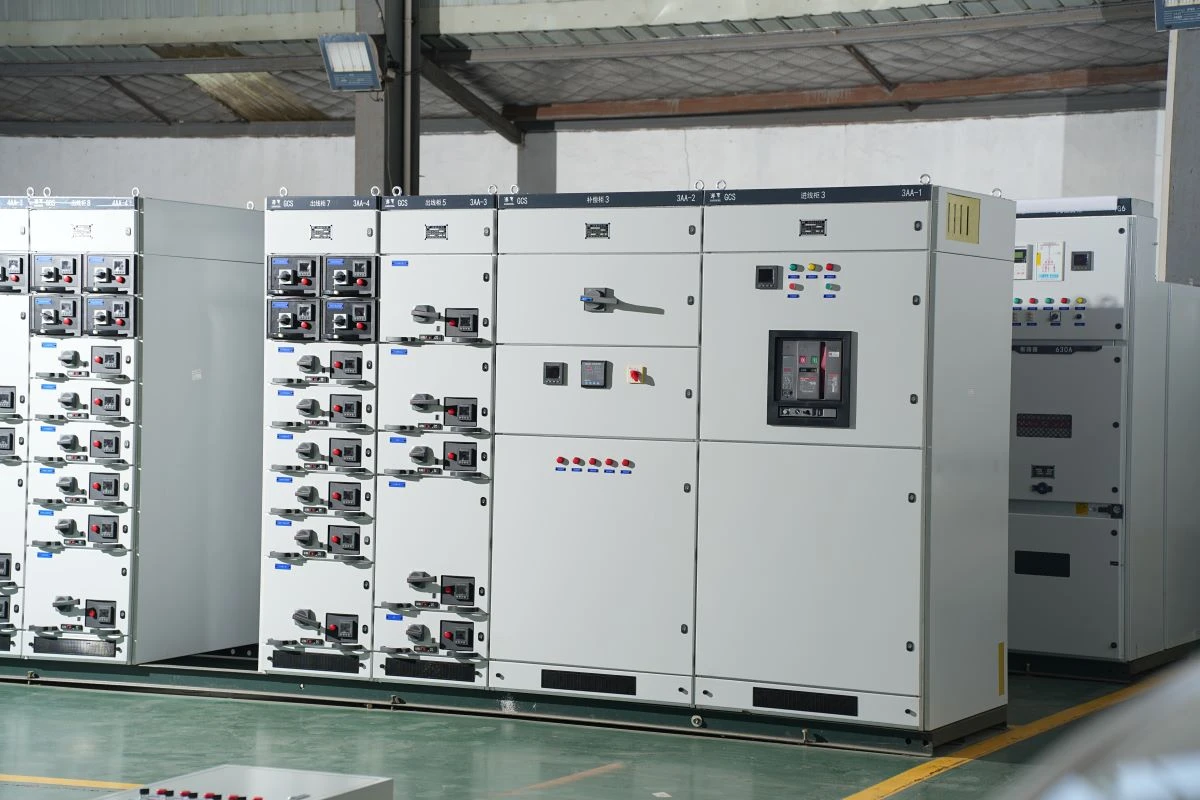
GCK Switchgear
FAQ
Is withdrawable switchgear suitable for hospitals?
It can be suitable where the project benefits from withdrawable functional units and structured maintenance, but suitability depends on the complete electrical design, applicable codes, protection requirements, and operational strategy.
What is the difference between modular and withdrawable switchgear?
Modular describes how functional sections or units are organized and combined, while withdrawable describes the removable or withdrawable construction of functional units. A switchgear system can incorporate both features.
What should I provide for a hospital switchgear quotation?
A single-line diagram, transformer capacity, voltage, expected current, short-circuit level, feeder schedule, motor loads, control requirements, installation conditions, applicable standards, and quantities will normally provide a strong starting point.
Can GCS or GCK switchgear be customized?
Yes. GangHeng states that customers can provide technical parameters, drawings, equipment power, site information, and required functions so that a customized switchgear solution can be developed.
Should a hospital use the highest-rated switchgear available?
Not necessarily. Rated current and short-circuit withstand should be selected from the project's actual electrical calculations and future requirements. Oversizing every component can add unnecessary cost, while underspecification can create technical and operational risks.