

Most switchgear problems on an industrial park do not start in the factory. They start in the purchasing meeting, when three contractors, two consultants and an owner's engineer each read the specification differently.
This article walks through a typical scenario that procurement teams, EPC contractors and distributors meet again and again. It is a composite scenario, not a report on a named customer or project. The load figures and phasing are assumptions we use to show the decisions involved. Every product specification quoted comes from Gangheng Electric's published product data.
The Scenario: A Three-Phase Park in a Cross-Border Setting
Imagine an industrial park built for overseas investors in a region such as the Middle East, Africa or Central Asia. The park is developed in three phases:
- Phase 1: two production halls and a utility building
- Phase 2: four more halls and a warehouse zone
- Phase 3: offices, a canteen and expansion bays
The EPC contractor buys equipment in China and ships it to site. The low voltage system runs at 380/400 V, 50 Hz. The owner wants all phases to look and behave the same, so the park's maintenance team does not need three training programs.
The word "cross-border" matters here. The equipment is made under one set of standards, shipped across borders, and accepted by a consultant who may be used to another set. That gap causes most of the trouble.
Challenge 1: One Park, Several Rulebooks
The first question an experienced buyer asks is which standard the equipment is built to. If this is left vague, the cost shows up at inspection, when a consultant rejects a panel on documentation rather than on quality.
Read the standard on each product page, not on the brochure cover. The Gangheng published data lists these standards:
- The MNS series is manufactured to IEC 60439, VDE660, GB7251-97 and JB/T9661.
- The XL series distribution panel is built to GB7251.
- Both MNS and XL pages state that ANSI/IEEE or BS compliance can be arranged on request.
Plain-language note: IEC is the international body whose standards many export markets use as a reference. GB is China's national standard. "Built to a standard" and "tested to a standard" are not the same thing, so ask for type test reports early. Gangheng states that type test reports are available on request.
Practical rule: put the required standard in the tender documents and the purchase order, and confirm it per product line before the order is placed. If a project needs a standard other than the published one, say so in the first inquiry rather than at the factory acceptance stage.
Challenge 2: Phased Construction Needs a Tiered Design
A park that grows in phases needs equipment that can grow with it. The most common mistake is buying the Phase 1 panels as a one-off, then discovering in Phase 2 that the same model has different dimensions or the layout no longer matches.
A simple way to avoid this is to split the low voltage network into three tiers and choose one product family for each.
Tier 1: The main intake and heavy feeders → Complete Switchgear
At the top of the system sits the 【Complete Switchgear】. Complete switchgear means factory-assembled cabinets that combine incoming breakers, busbars (the copper bars that carry the main current) and outgoing circuits in one tested lineup.
The MNS series fits this tier. Its published figures include:
- Horizontal busbar rated 630–4000 A
- Rated operating voltage 380 V / 660 V
- A modular E = 25 mm frame
- Up to 36 outgoing circuits per functional unit
- Drawout functional units that can be withdrawn while the main busbar stays live
- IP30 / IP40 / IP54 protection options, with IP54 as a configuration option
For a phased park the modular frame matters. Each new phase can add functional units to the existing lineup instead of replacing it.
Tier 2: Motor control and large feeders → Low Voltage Switchgear Cabinet
Production halls bring pumps, compressors, fans and machine drives. Here a 【Low Voltage Switchgear Cabinet】 of the drawout (withdrawable) type is the practical choice. Drawout means each circuit sits in a drawer that can be pulled out for service without disturbing its neighbors.
The GCS series gives the following published data:
- Horizontal busbar up to 4,000 A, vertical MCC busbar 1,000 A
- Cabinet widths of 400 / 600 / 800 / 1,000 mm and depths of 800 / 1,000 mm
- Drawer height modules from ½ unit to 3 units
- IP30 / IP40 protection
- Mechanical interlocks on each drawer to prevent incorrect insertion or operation
- Compatible with dry-type transformers for a compact combined assembly
The choice of widths and depths helps when switch room sizes differ between buildings.
Tier 3: Floor-level and building loads → Distribution Panel
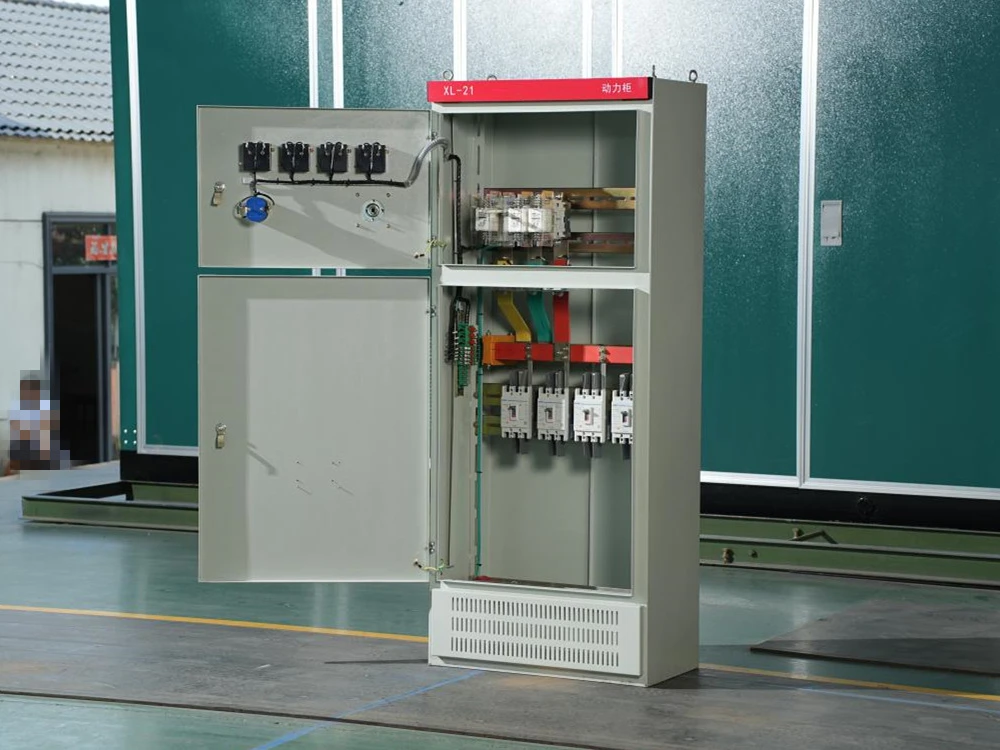
At the far end of the network are lighting, small power and auxiliary loads. A 【Distribution Panel】 such as the XL series covers this tier. Its published ratings are:
- 380 V operating voltage, 220 V also supported
- 630 A horizontal busbar
- 15 kA short-time withstand current and 31.5 kA peak withstand current
- IP30 protection, built to GB7251
- Three-phase three-wire and three-phase four-wire layouts
- Customised circuit arrangements and dimensions accepted
Plain-language note: short-time withstand current is the fault current a panel can survive for a short period (usually one second) without damage. It must be higher than the fault current at that point in the network. This is why the 15 kA XL panel belongs at the end of the system, where fault levels are lower, and not at the main intake.
The point for buyers: one product family per tier, bought in the same specification across all phases. The park then ends up with three types of cabinet instead of eight, which means fewer spare parts and a shorter training list.
Challenge 3: A Lead Time That Matches the Construction Program
Switchgear is usually on the critical path. If the cabinets arrive late, the halls cannot be energized, and every trade waiting behind them loses time.
Gangheng's published lead times scale with the order value:
There is no minimum order quantity, so a first-phase order for a few cabinets is accepted, as is a later top-up order. Lead times for custom configurations and for individual projects should be confirmed when the order is placed.
Buying tip: a phased park can often save time by placing the Phase 1 and Phase 2 orders together when the design is already frozen. A larger single order, within the same lead-time band, avoids a second round of drawings and approvals. Check whether this fits the owner's payment schedule before you commit.
A Buyer's Checklist: How to Avoid the Common Pitfalls
These points come from the challenges above and apply to most export switchgear projects.
- Freeze the standard first. Confirm it per product line and ask for type test reports before order confirmation.
- Match the tier to the fault level. Do not use a distribution panel where the fault current needs a full switchgear lineup.
- Specify environment options at the start. Dust and humidity push projects toward IP40 or IP54, which on the MNS series is a configuration option. The MNS data lists ambient limits of −5 °C to +40 °C and altitude up to 2000 m, so hot sites should be reviewed with the engineers before the cabinet is finalized.
- Prepare the ordering documents. For custom orders, Gangheng asks for items such as the main circuit single-line diagram, the secondary (auxiliary) schematic, the component list and the electrical ratings. For distribution panels, it asks for the primary and secondary diagrams, the device list and the dimensional requirements. If the customer has no drawings, the site details, equipment power and functional requirements can be provided instead, and engineers will help derive the scheme.
- Keep spare-parts logic in mind. Using one family per tier also simplifies the spare parts list. Gangheng states that spare parts are priced no higher than market price.
- Read the warranty terms. The published terms are 12 months free repair after acceptance, plus 5 years of responsibility for latent defects after the warranty ends.
Conclusion
A cross-border industrial park does not need exotic equipment. It needs a clear standard, a tiered design that can be repeated phase after phase, and a supply schedule that fits the construction program.
If you are planning a similar project, start with three actions this week:
- Write down the standard each tier must meet.
- List the circuits for each phase, so tiers and cabinet widths can be fixed early.
- Collect the single-line diagram and load list before sending the inquiry.
With those in hand, a supplier can give you a realistic quotation and lead time. You can send the drawings or site data through the Request a Quote page, and the engineering team will respond with a proposal.
FAQ
- 1. What is the difference between complete switchgear and a distribution panel?
Complete switchgear (such as the MNS series) forms the main distribution lineup with high-current busbars and drawout units. A distribution panel (such as the XL series) serves the end of the network with lower current and fault ratings, for example lighting and small power loads.
- 2. Can I order a single cabinet, or only large batches?
There is no minimum order quantity, so a single cabinet can be ordered. Bulk orders and phased orders are also accepted.
- 3. What documents are needed for a custom order?
Typically the main circuit diagram, the secondary schematic, the component list and the electrical ratings. For distribution panels, the external dimensions are also needed. If you cannot provide drawings, supply the site conditions, equipment power and required functions, and the engineers will help work out the scheme.
- 4. How long does delivery take for an export project?
Published lead times are 30 days for orders up to USD 300,000, 45 days up to USD 700,000 and 60 days up to USD 1.5 million. Confirm the exact schedule for custom configurations at order stage.
- 5. Which standards can the equipment meet?
The MNS series is built to IEC 60439, VDE660, GB7251-97 and JB/T9661, and the XL series to GB7251. For projects that need ANSI/IEEE or BS compliance, this can be arranged on request. Confirm the standard for each product line before ordering.